Showing posts with label research. Show all posts

Sunday, August 22, 2021

Lip Sync research, Adobe Character Animator, 22 August, 2021

Adobe Character Animator lets you rig a 2D puppet and have it do lip syncing in real time.  

 https://www.youtube.com/watch?v=PD9-zrGxrs4

How does this work?  Can it "listen" to a song and then work with the puppet to match the voice to the lips?


It looks like the program identifies the performer's mouth (see red lines in live view box at upper right of screen)
This tutorial: https://www.youtube.com/watch?v=Ka6ikizX0pY
Shows how you lip sync JUST THE MOUTHS in CA and then export them to After Effects or Mojo.  The software will analyse outside audio and match the lips.
Setting up the head puppet in CA tutorial: https://www.youtube.com/watch?v=7GKCw4f1UrI
Incredible!!!  Do this with GIW "Today's the Day!"
Test Anna or Kath singing
Holy moly, exciting stuff.


Monday, January 8, 2018

Wednesday, November 22, 2017

Research, hi-tech for mascot-making, 22 November, 2017

Today I had a great conversation with Kristine!  The mascot company she works for sounds amazing and they're committed to upgrading to hi-tech systems.  Rachel from UNC put them on to this software:
http://optitex.com/
It's what I had hoped Marvelous Designer would be.  Quite excited about discovering this!  BUT the questions as always is this:  Can you program it to use stiff materials, like foam, that will sit away from the body?  Can you create a non-human proportional, cartoony, body?  If you can't do either of those things, how  useful is it to mascot making?  Items like cape or undergear that goes against the performer's body or slopers that are then built on are doable but does that justify getting to know the software?

K told me that they hand prep and cut all of Big Bird's feathers.  What does that entail?  And can a laser cutter speed things up?  I went to visit the local laser cutter business on Tay St. and Lana was very helpful.  She showed me how the machine works, what the software requires (Corel Draw for vector graphics) and how it interfaces with the lasercutter's software.  She cut the fur that I brought in and we got this:

Set on 300/30, the lc cuts slowly enough that a full separation at a shallow depth is achieved.  The edges of the synthetic are cauterized which means it won't unravel or need to be overlocked.  The length of the fur is untouched and the clean up is minimal as a result.  The lc can also "score" the fabric on a lighter setting.  where the laser touched the fur can be seen in the yellowish straight lines around the piece and inside it.  

 The lc was programmed to cut a shape with little notches along one edge.  Those notches are straight and consistent.  The machine can cut as many shapes out as you might require and no blades will grow dull and they will always be the same size and shape.

For a personal application, this would be incredible for making furry beanbags: both the circles of the polka dots AND the circles inside the purple fur that the coloured dots get set into.

When I visit on Friday, I will take various kinds of foam in to see if those can be cut by the lc and what the results are. 
Link to laser cutters on sale through amazon.com:
https://www.fabathome.org/best-laser-cutter-engraver/


Tuesday, November 21, 2017

Research: Death Scenes in Miniature

https://www.pbs.org/newshour/arts/photos-these-gruesome-dollhouse-death-scenes-reinvented-murder-investigations
Courtesy of the Renwick Gallery

Absolutely fascinating!  You could do this in 3D and put them into VR for crime scene training or for amateur sleuths.  VR is not cheap, and it is NOT easy.  I had a good conversation today with Nash Varghese of Digital Stock.  Their ph is $180 and just setting up one platform, like android, can cost $20k for the most basic app.  And it is a solitary experience- each person puts on their own goggles and wanders around in their own little world in a very limited space. 
Frances Glessner Lee, the “godmother of forensic science,” at work on her Nutshells.
These are the so-called “Nutshells,” death scenes created by 20th century heiress, scientist and artist Frances Glessner Lee, the “godmother of forensic science,” who made these dioramas of real-life cases to help future investigators do more accurate forensic crime analysis.

Monday, November 20, 2017

Research, "Just Breathe", 20 November, 2017

https://amysmartgirls.com/short-film-just-breathe-helps-kids-deal-with-emotions-1b4f91dac5ad

Research, A girl-led world, 20 November, 2017

http://www.cartoonbrew.com/internet-television/crafting-show-netflix-guru-studios-frank-falcone-true-rainbow-kingdom-153297.html

"True and the Rainbow Kingdom."

Sunday, November 5, 2017

BSA303, children's tv and emotional skills, 5 November, 2017

https://www.psychologytoday.com/blog/psyched/201402/can-tv-promote-kids-social-emotional-skills

Positive TV content can help.
Content matters.  Look for cooperation and helping. Look for positive behavior throughout the episode.
Consider your child’s age.
Get involved. Point out characters’ positive behavior and discuss why it’s helpful. Encourage your child to use new skills.

References
Christensen, C. G. (May, 2013). Effects of prosocial television on children’s social and emotional competencies: A systematic review. Paper presentation in a symposium at the annual meeting of the Midwest Psychological Association, Chicago, IL.
Christensen, C. G., & Myford, C. M. (in press). Measuring social and emotional content in children’s television: An instrument development study. Journal of Broadcsting & Electronic Media, 58. 
Mares, M.-L., & Acosta, E. E. (2008). Be kind to three-legged dogs: Children’s literal interpretations of TV’s moral lessons. Media Psychology, 11, 377-399. 
Mares, M.-L., & Woodard, E. (2005). Positive effects of television on children’s social interactions: A meta-analysis. Media Psychology, 7, 301–322.

BSA303, NZ children's tv, 5 November, 2017

Just double checking that I'm doing something unique in NZ kid's tv.  Wikipedia's list isn't complete because Little Monstars and Mukpuddy's Barefoot Bandits aren't on there.  What else is missing?  And how would I find it?

Milly, Molly is a series of New Zealand children's books by Gill Pittar. It is about the adventures of two little girls from different ethnic backgrounds, and the books promote the acceptance of diversity and the learning of life skills. There is an animated television series based on the books.
https://en.wikipedia.org/wiki/Milly,_Molly

show about life lessons but not the ones I'm working on.  phew!

Oscar and Friends  The show is about a 7-year-old boy named Oscar, who, with his imaginary friends, goes from adventure to adventure. In this fantasy life of his, Bugsy, a bright green, bug-eyed mischievous coward, and Doris, a daring, eccentric girl and Oscar's confidante, are there to rescue him in danger and lend a hand.[3]
Oscar and Friends is a 26-episode claymation children's series from New Zealand that ran from 1995–1999. The series was made in Wellington, New Zealand, and was aimed at children aged 3 to 6. The series was produced by Gnome Productions Ltd., distributed by Southern Star Sales, and funded by NZ On Air and Southern Star Entertainment. Oscar and Friends" has been screened all around the world including on ITV in UK (where the series rated number ten for kids in its first year of release), Fox in USA, ABC in Australia.[2] and Magic Kids in Argentina.
https://en.wikipedia.org/wiki/Oscar_and_Friends

stop motion characters over painted backgrounds


Sparkle Friends Sparkle Friends is a New Zealand animated series produced by Mukpuddy Animation for New Zealand's long running children's show, What Now. The series stars the What Now presenters as children and a creature named Gun-gi, who vomits gunge, something that features heavily in What Now.
https://en.wikipedia.org/wiki/Sparkle_Friends

Hilarious- Jeremy Dillon + Mukpuddy equals a new favourite produced-in-NZ show!

Wednesday, October 11, 2017

BSA324, Charles Schulz used Peanuts as a biography, 11 October, 2017

Schulz Sketched Own Life in 'Peanuts' Strip
October 16, 200712:01 AM ET
David Michaelis, author of Schulz and Peanuts: A Biography, said he noticed a connection between the Peanuts strip and Schulz's life as he researched the book.
For example, as Schulz began to find success with sketching, his father warned him not to get a big head, Schulz said. Years later, Schulz created the Charlie Brown character, whose main feature is an enormous head. And Schulz, like Charlie Brown, consistently absorbed rejection and moved forward in life.

BSA324, Sesame Street and trauma support for kids, 11 October, 2017


"The videos and activities are designed for both children and caregivers to watch or use together, a two-generation approach meant to nurture relationships that can dramatically improve a child’s chances of healing from traumatic experiences. Research shows that a consistent, caring adult is the most effective buffer for a child’s stress. Additional materials designed just for adults explain more about the research and strategies behind how traumatic experiences affect children and how they can help."
Chandler, M. A. (2017, October 6). Sesame Street launches tools to help children who experience trauma, from hurricanes to violence at home. The Washington Post, p. 1. Retrieved October 11, 2017, from https://www.washingtonpost.com/news/inspired-life/wp/2017/10/07/sesame-street-launches-tools-to-teach-coping-skills-to-children-who-experience-trauma-of-all-kinds-from-natural-disasters-to-violence-at-home/?utm_term=.5474f66f49c8


For Traumatized Children, An Offer Of Help From The Muppets


Ann Thomas is CEO of The Children's Place in Kansas City. It's a full-day therapeutic program for children who, on average, have experienced five traumatic events before the age of 6. "They've had some really hard starts in life," she says. "That does impact their development."
Thomas consulted on the new material, even visiting the set when the Muppets were filming.
Though the videos speak directly to children, Thomas thinks they can also help adults. "I think one of the biggest values of this material is as a bridge for adults to take grownup issues and put them in developmentally appropriate words to help children heal," she says.
This is a skill that even the most well-intentioned grandparent, teacher or foster parent may not have. "When it's your child, you don't want them to hurt," she says. "Sometimes we want to say, 'get over it.' It's hard to be with a child in that pain."
She notes that it can be comforting in itself for children to see familiar characters dealing with these emotions. Traumatic experiences are sadly common, but not much talked about in most kids' media.
"When it's done by Sesame it gives it credibility," she says. "If Sesame is doing it you're not alone."
She applauds the focus on skills to manage emotion, rather than having Muppets delve into what caused the emotions. This mirrors the course of treatment for children moving beyond trauma.
"Teaching these coping skills first, creating a sense of safety, consistency and predictability — that is the No. 1 step," she says. "It doesn't matter if it was sexual abuse or a house fire. You're scared, you're not trusting, you're not sleeping."
Kamenetz, A. (2017, October 11). For Traumatized children, An Offer Of Help From the Muppets. Retrieved from NPR: http://www.npr.org/sections/ed/2017/10/06/555363108/for-traumatized-children-an-offer-of-help-from-the-muppets?utm_source=facebook.com&utm_medium=social&utm_campaign=npr&utm_term=nprnews&utm_content=202706

Tuesday, September 12, 2017

BSA324, BSA303, Research reading list, 4 August, 2017

•Children and Media in Times of War and Conflict by Emily Moyer-Guse’
•Children, television and emotions: A Summary of Selected Research Findings by Heike vom Orde

•ChildEducation Through Animation: An ExperimentalStudy by Md.BaharulIslam,  ArifAhmed, Md. KabirulIslam andAbu KalamShamsuddin 
abstract:  visual learning can be easier for children to understand and when combined with verbal instruction is the most successful teaching method.
key words: blended learning, visual learning


Social and emotional learning interventions are most effective when their content and method of delivery are matched to children's developmental stages;
The adults who deliver social and emotional learning programs are, in large part, responsible for the success or failure of the program. If adults lack social and emotional learning skills themselves or suffer from stress or poor physical and mental health, their ability to support their students' social and emotional learning may be severely compromised.

Read more at: https://phys.org/news/2017-05-social-emotional-essential-children-success.html#jCp


Read more at: https://phys.org/news/2017-05-social-emotional-essential-children-success.html#jCp

Ruth?  CPIT
Read NZOnAir charter

Saturday, August 12, 2017

BSA303, BSA324, mental health in animation and children's TV, 12 August, 2017

Rick and Morty and Family Therapy
 "I have no doubt that you would be bored senseless by therapy, the same way I’m bored when I brush my teeth and wipe my ass. Because the thing about repairing, maintaining, and cleaning is it’s not an adventure. There’s no way to do it so wrong you might die. It’s just work. And the bottom line is some people are okay going to work, and some people, well, some people would rather die. Each of us gets to choose.”
I found this episode to be both really funny and really thought-provoking.  I wonder how much of it was based on the writer's experiences with therapy and how much was based on an actual therapist's input.
Kane, V. (2017, August 9). Rick & Morty’s Heartbreakingly Honest Take on Therapy Was the Most Painful Thing on Television This Week. Retrieved from The Mary Sue: https://www.themarysue.com/pickle-rick-therapy/

Bojack Horseman and Depression

"It’s never explicitly said that BoJack is depressed, but you can see the signs, and it’s the sort of portrayal you rarely see on television. It’s not about lying around all day and crying; it’s asking tough questions of who you really are. In BoJack’s case, this means asking how responsible he is for his own actions. Depression can be an overwhelming disorder, one that distorts the world and betrays the mind. But is BoJack’s horrible behaviour his fault, or beyond his control – a neglectful childhood, perhaps, or being “born broken”?"

Caldera and psychoaffective disorder
"In our differing understanding of reality, we blindly mandate his medication, assimilate him to our marginalizing culture, and entirely misinterpret him for all he is worth. Caldera aims to not only venerate my father, but all brilliant minds forged in the haunted depths of psychosis."

10 films (including Caldera) that show mental disorders in the most subtle way

Alfred and Shadow

A short story about emotions (education psychology health animation)

Inside 'Inside Out'
This stunning and popular movie should be required viewing for anyone in the mental health field. Joy and Sadness' Homeric journey through Riley's mind takes them through Imagination Land, Abstract Thought, and Long-term Memory, past “retrieval tubes” and deep into the Subconscious (“where they put the trouble-makers”). The parent–child story is universal—repressing feelings to suit perceived parental needs, but ultimately needing to mourn childhood memories in order to grow up. Director Pete Docter turned to esteemed affect researchers Paul Ekman and Dachel Keltner to help him understand how and why people develop and change. But these Snap, Crackle, and Pop-like feelings do more than discharge—they think, analyse, and ultimately realize that they all need to be conscious in order to help their young charge love and work. Maybe it's not so far from the couch after all.


Cabaniss, D. L. (2015, September). Inside “Inside Out”. Lancet, 2(9). Retrieved 8 12, 2017, from http://www.thelancet.com/journals/lanpsy/article/PIIS2215-0366(15)00395-8/fulltext

Vincent and the Doctor
Doctor Who visited Vincent Van Gogh in season 5 episode 10 of the popular British children's sci fi tv series.  Vincent's depression is shown and he is able to talk about his feelings about his sadness and great joy in painting.  

BSA303, BSA324, BSA306, So This Happened series, 12 August, 2017

I'm not sure if I'm still researching difficult subjects + engagement + animation anymore; at this point, it's just reflexive.

This TVNZ series tells the story of NZ women's experiences with sexual harassment.
So This Happened 1
Story by Shannon Addison, animation by Joelle Douglas

These episode create separation  by using soft pastels and a monochromatic palette on the backgrounds and bright colours and black outlines on the main characters.
So This Happened 2
Story by Shannon Addison, animation by Teahi Maiau

The subject matter is difficult, sometimes for both storyteller and viewer, and seeks to leave the storyteller stronger for having told their story.  Many of these segments have dealt with abuses suffered during what is still childhood- the early teen years.


Thursday, August 3, 2017

BSA303, BSA324, Research Priority, 3 August, 2017

kidscreen.com
kidsonscreen.co.nz/research/
Youth Media Alliance (Canada)
look for Australia and Britains, too
look up Rachel Mann's thesis online to look for reference list

Questions to answer regarding my project:   from Kathryn
Can you put more of the narrative/concept with the puppets etc. at the front of your question
Imagination Warehouse- what is it?  How does it relate to your question?
Why these characters?
How do these characters reflect children's issues and problems.
Why this aesthetic?
What age group is this for?

https://scholar.google.co.nz/scholar?cites=3999557817773906180&as_sdt=2005&sciodt=0,5&hl=en
http://www.tandfonline.com/doi/abs/10.2752/089279396787001400?journalCode=rfan20
https://www.babble.com/toddler/imaginary-friends-early-child-development-imagination/

Research imaginary friends in children's television
look for current citations of these articles

Imaginary friends help kids learn article news-medical.net
According psychologist, Dr. Evan Kidd at Melbourne's La Trobe University the phenomenon of the imaginary friend is really misunderstood and people think it is rare and a concern but past studies have shown that around 65% of children aged between three and nine, had imaginary friends and the characters, rather than due to some internal malaise, appear to be an essential component of normal development.  children with imaginary friends are better at learning to communicate than other children because they have a lot of practice at inventing interactions with their friends, which helps them improve their conversational skills.
Dr. Kidd has established in his research that the benefits of imaginary companions are long lasting - a study of university students showed that those who recalled having an imaginary companion in childhood were more creative, more achievement oriented, and more emotionally responsive than students who didn't have one.


Dr. Evan Kidd at Sydney TEDX
from LaTrobe University in Melbourne
26 May, 2012
imaginary friends, personified objects like teddy bears with names.  most famous is tiger hobbes from Calvin and Hobbes
derives from play. "Theory of Mind' says people's behavior driven by their internal mental states.


Imaginary friends and real-world consequences: parasocial relationships | Jennifer Barnes | TEDxOU


Adults need more imaginary friends | Andrew Roblyer | TEDxTAMU
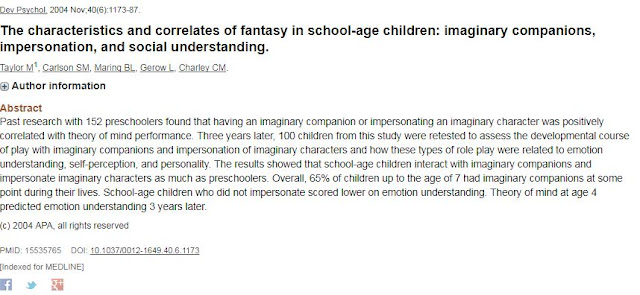
https://www.ncbi.nlm.nih.gov/pubmed/15535765
given tendency of older kids to act out fantasy less overtly than younger kids, parents may underestimate ages at which imaginary companions abandoned or be unaware of newly created ones.  looked at imaginary friends and personified objects(p1)
role play with imaginary companion involves imagining characteristics and perspective of another individual.  preschool girls more like to have imaginary friend where boys more likely to impersonate imaginary character. children who create IF more sociable and less shy, more creative, participate in more family activities, show more positive affect in their play with other children.  socially competent andcreative adolescents with good coping skills were particularly likely to refer to imaginary companions in their diaries.   (2)
 majority of IF played with by older children are inisible, whereas half of younger children are based on props such as special toys.  (13)
look at research behind how children adapt from being in families to larger environments like schools
why do children have imaginary friends and why are they important?

Monday, July 31, 2017

BSA303, dissertation outline, 24 July, 2017

For my next one-on-one with Ruth (I've missed the first three), I need to have a one-page bullet pointed revised proposal AND develop a brief outline (couple pages max) of mydissertation (title, main focus/question, main parts/content- just bullet points – using any template (or part of)  in workbook to help or develop my own structure.

Thursday, July 27, 2017

BSA306, Stop Motion practitioner Lauren Horoszewski and Supermansion/ Robot Chicken, 26 July, 2017

Here's another stop motion show to check out:  Supermansion.
http://au.ign.com/articles/2015/10/06/robot-chicken-producers-on-the-differences-youll-see-in-supermansion
When I started researching it, I found this woman's online portfolio and resume:

http://www.laurenhoroszewski.com/


She has lots of good process shots of her work for the show and I was amazed to find that she had gone to University of Connecticut and studied sculpture and puppetry.

Not everybody likes the jokes on Supermansion but the puppets look really good and Stupid Buddy does good stop motion animation.

Tuesday, July 25, 2017

BSA303, BSA324, kids get to choose their own path through the story, 25 July, 2017

Netflix Interactive Storytelling Lets Viewers Choose Their Tale

 - Jun 21, 2017
References: media.netflix
Netflix customers will soon be able to enjoy Netflix Interactive Storytelling as a new kind of experience that transforms viewers into directors of their own TV adventures.

This will be interesting for viewers and for content creators who will now have to make alternate endings and paths for their characters to take.  It seems to move viewers to the more active role that video game players take in deciding which directive to follow, or influence, the narrative.

Puss In Book: Trapped In An Epic Tale Trailer

Story choices can be selected on tv with the remote or directly on touch screens.

And for those that can't deal with the randomness of life, let alone choose your own adventures, full decision trees are available online so adults can help "guide" children in their choices to get to the end of the story.  

Buddy Thunderstruck:  The Maybe Pile is another title that Netflix is supporting in this format.
stop-mo from Stoopid Buddy Studios (Robot Chicken) and American Greetings Entertainment (Strawberry Shortcake)

It's an "experiment", according to Netflix, and is currently only available on "some modern smart TVs, game consoles, iOS devices, and Roku devices" but "won’t be available on the web, Apple TV, Chromecast, or Android devices".  So I won't be able to test it.  Boo!

Depending on your choices, Puss in Boots is 18 to 39 minutes long. 
(I watched the default choices version on Netflix for web viewers.  It was good! At 20 minutes long, I missed half of the possible storylines.  The whole viewing tree may be "released" on youtube at some point.)  
Fisher says her work began with one overarching question: what stories can we tell at Netflix that can’t be told elsewhere? “Netflix is an interactive device ecosystem,” she says. “We’re not beholden to terrestrial television. We’re not beholden to linear schedules.” 

Where will this all lead?  I read an analysis of women's underwear in the 20th century that said when children stopped being strapped into girdles and restrictive underwear they grew up to be adults who expected the same level of comfort.  Hence the revolution in cotton and stretch fabrics that led to the abandonment of heavy shapewear in the 60s and 70s.  If children today grow up getting to choose their own way through the story, they will one day be adults who will not be content to be force fed narratives like we are today.  Imagine watching a sprawling epic like Game of Thrones and getting to focus on only one character's storyline or skipping through tedious "character building" moments to only watch the battles?